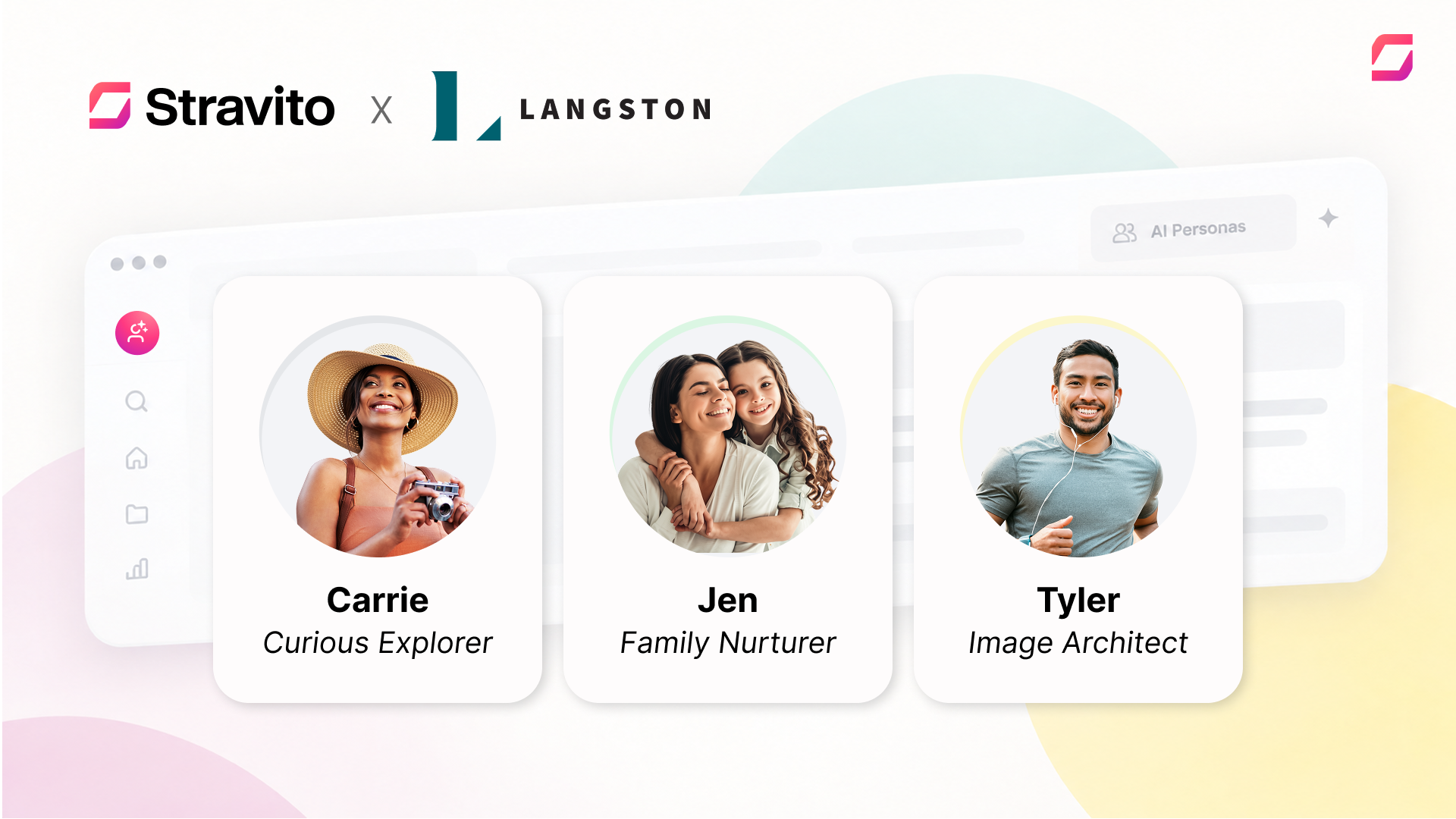

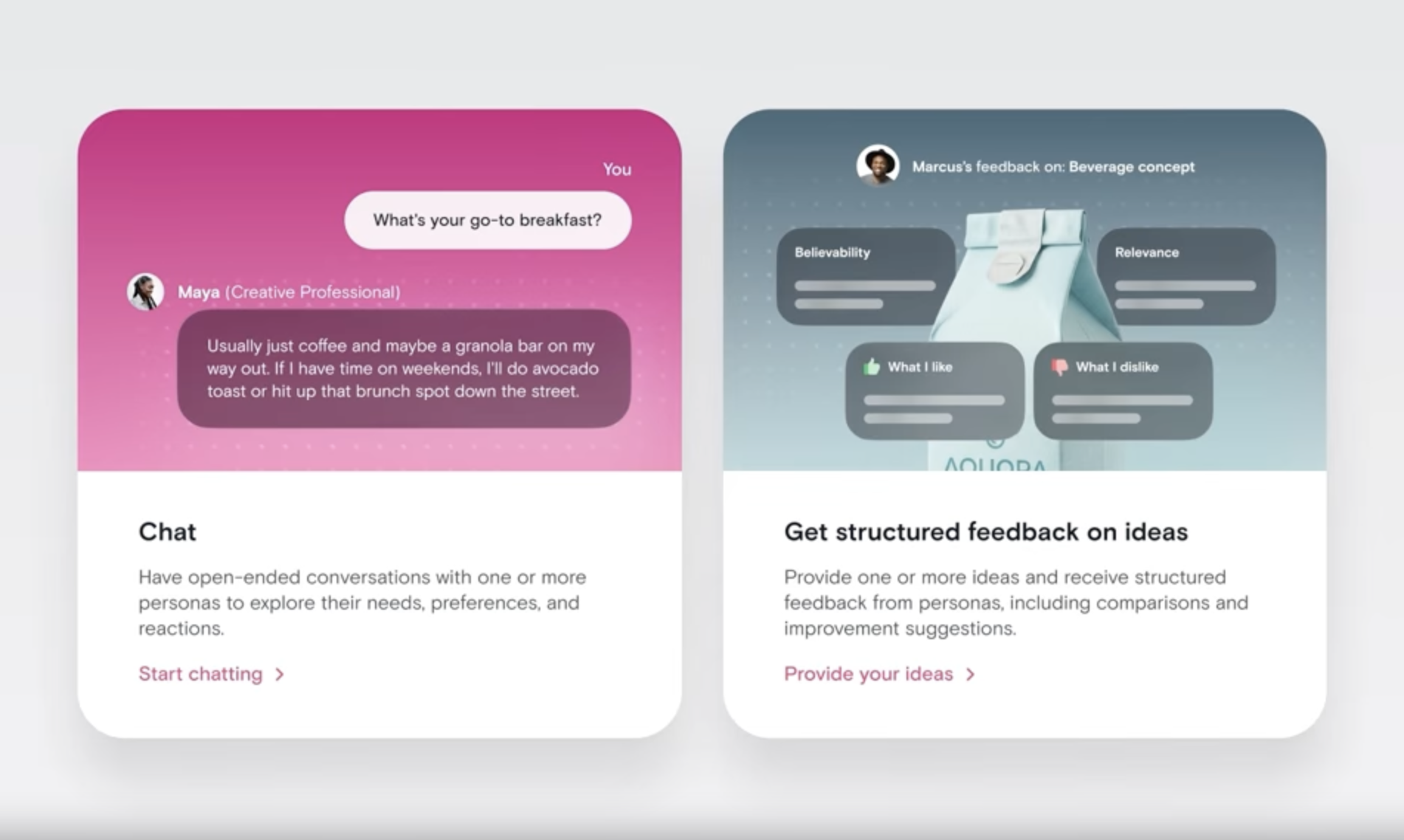
Stravito AI Personas give marketing and insights teams an interactive way to apply existing research to concept development and messaging. These four use cases show how teams can explore audience perspectives and refine ideas while keeping the supporting evidence in view.
- Four ways to activate existing research: Use AI Personas for one-on-one conversations, group feedback on visual concepts, messaging refinement, and side-by-side concept comparisons.
- Traceable evidence throughout: Every answer links back to source research, and teams can inspect the evidence supporting each AI Persona’s traits.
- Faster concept screening in practice: Danone used structured comparisons to narrow 100 concepts to 30 in just 24 hours, rather than the usual one to two months.
During our guided tours at Le Printemps des Études, we walked marketing and insights leaders through four ways AI Personas turn the research already sitting in your library into something you can actually act on.
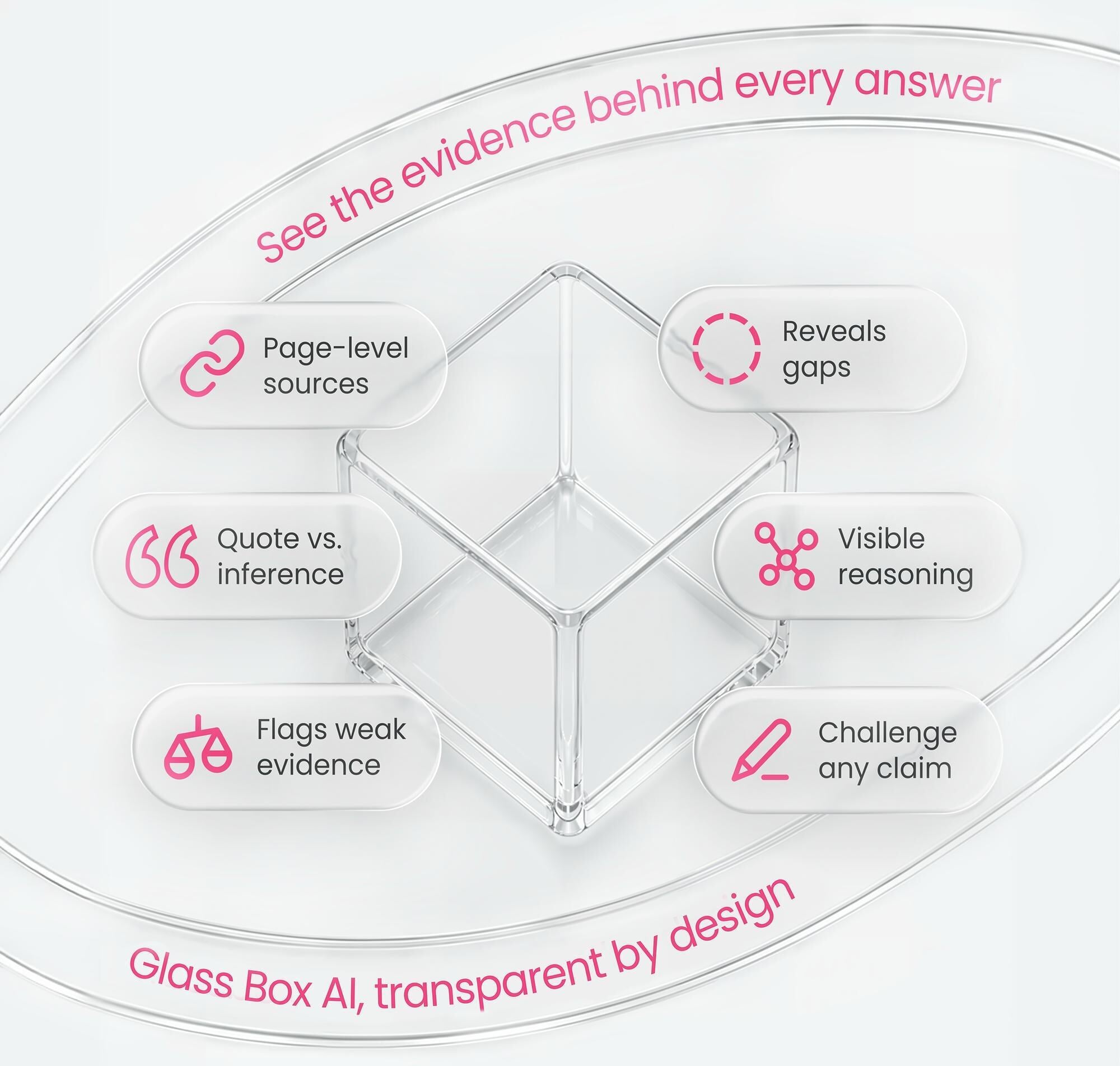
At Stravito, every AI Persona starts the same way: built from core definition material — segmentation research, focus group transcripts, whatever forms the target audience's foundation — with each trait tagged by how much evidence supports it. That's Glass Box AI in practice; you can always see the sources behind an AI Persona, how recent they are, and what topics they cover, before you ever ask it a question. Here's what that looks like across four real use cases:
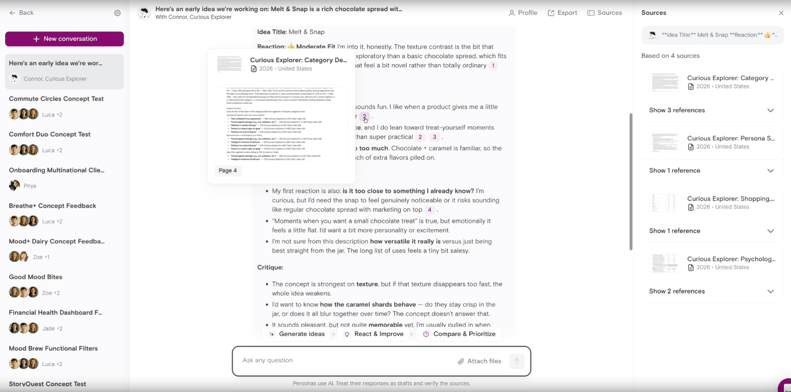
1. Speaking with an AI Persona one-on-one
The simplest entry point is a direct conversation. For example, we can ask Connor, one of our AI personas, for his honest reaction to a concept called Melt & Snap — a rich chocolate spread — including what excites him and what gives him pause. Connor's answer will come back with several distinct points, but the most important part isn’t the opinion itself: every claim links back to the exact page, in the exact report, that it comes from. Whether that source is the segmentation research the AI Persona is built on or a market report from the knowledge library, you can always trace an answer to where it originated.
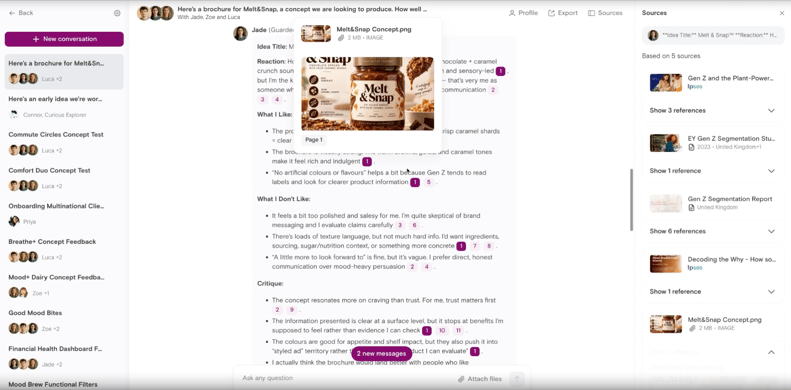
2. A mini AI “focus group” on a visual concept
AI Personas don't have to work one at a time. We can bring together three Gen Z AI personas — Luca, Jade, and Zoe — and ask them to react to an actual brochure image for Melt & Snap, not just text. Each will give feedback on fit, on the concept information, and specifically on how the visual reads.What stands out is that three AI Personas from the same generation still give meaningfully different reactions, each grounded in the specific segment they represent.
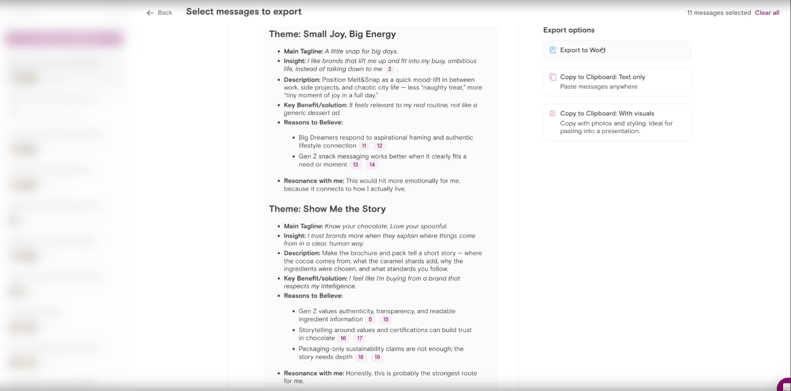
3. Turning group feedback into sharper messaging
A group of AI Personas can also generate ideas rather than just react to them. If we ask them how to make Melt & Snap more appealing, each AI Persona will answer through their own lens. Luca, an authenticity seeker, wants more honest, specific language — indulgence that feels intentional rather than guilty. Jade, a guarded independent, wants plain facts over hype. Zoe wants something indulgent but still thoughtful. Every suggestion traces back to a real source, so it's grounded rather than invented — and the strongest ideas can be exported straight into a Word document or a PowerPoint slide.
4. Structured, side-by-side feedback across concepts
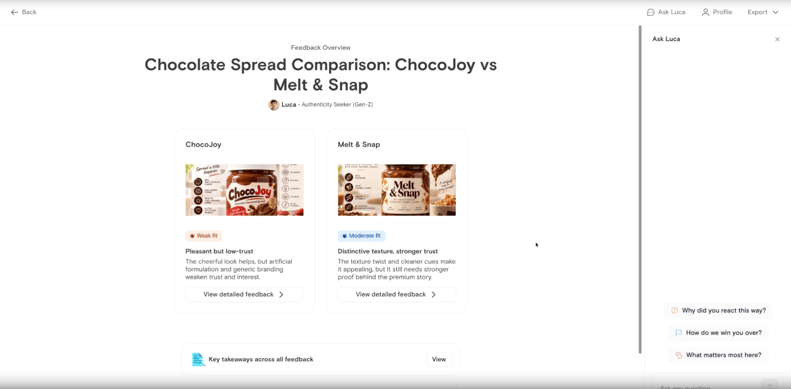
The last workflow compares multiple concepts at once rather than reacting to just one. Let’s say we introduce a new concept, Choco Joy, in addition to Melt &Snap, and ask Luca to evaluate both. The output we’ll receive is a side-by-side comparison with a fit score for each; Melt & Snap comes back a weak fit, Choco Joy a moderate one, each with the specific reasons behind the score, what worked, what didn't, and guidance for the next iteration. It's the same traceable-evidence approach as the one-on-one conversation, but structured for a decision rather than a discussion — and it exports as a ready-to-present deck.
It's also the exact workflow behind one of our favorite real-world examples. Danone's insights team used this same structured, side-by-side comparison to screen 100 concepts down to a shortlist of 30 — in just 24 hours, instead of the one to two months it would normally take.
The through-line: using AI Personas to inform decisions with traceable evidence
Across the four different workflows, every single answer is traceable back to a real source. The point isn't that AI magically understands your consumer. It's that the research you already have becomes something your team can actually use, faster, with real confidence in where each answer came from.
Want to learn more?
Read the full Danone case study or book time with our team to try it on your own concepts and discover how how AI Personas can drive better, faster decisions at your org.


Author