

TL;DR
AI can improve business decision making, but traditional “black box” systems often hide their reasoning, sources, and uncertainties, creating risk. Stravito’s Glass Box AI principles offer a solution. The model promotes transparency through traceable evidence, visible logic, and explicit uncertainty. By revealing what is known, inferred, and unknown, organizations can make more informed decisions. And, by highlighting what is not known, Glass Box AI can drive important dialogues about the need for more information.The use of AI to support complex business decisions is revealing an unexpected problem. While AI enables faster, richer data-driven analysis, it can mask opaque reasoning and low-quality citations with a deceptively authoritative voice. “AI said so” can be an easy default for this prevailing “black box” mode of analysis. This creates risk. If decision makers lack visibility into AI’s reasoning and sources, they may make judgement calls that lead to negative business outcomes.
An emerging Glass Box AI model at Stravito promises to resolve this problem. By surfacing detailed citations and clear reasoning, while also highlighting known areas of uncertainty, these Glass Box AI principles give decision makers the advantage of transparency. It lets them knowledgeably challenge assumptions. This article explores the issue, discussing the value of leaning into uncertainty as a way to gain the maximum benefit from powerful AI tools.
Making decisions means acting under pressure with incomplete data
Successful business management is about making decisions, often under pressure and without enough information or the time or budget to commission dedicated research. Consider the following scenario: A consumer packaged goods (CPG) company has to decide if it will sell its products in convenience stores in addition to supermarkets.
For decision makers to determine if it makes business sense to expand into this new sales channel, they need to consider factors like the impact of convenience store sales on supermarket revenue, the demographics of convenience store customers, and the impact of the move on the company’s brand image. The growth potential of the convenience store channel should also influence the decision, as should the potential for price and margin erosion from adding a new channel.
Each of these factors comprises a distinct, inevitably incomplete data set. Some of the data is external, some is internal, and some will come from experience and educated guesses. What’s not in doubt, however, is that the decision will result in a business outcome, either positive or negative.
AI offers a potentially powerful, but imperfect toolset for decision making
Using data to guide a decision is not a new process. Indeed, it predates the invention of the computer. Today, though, data analytics has sped up the process and improved its accuracy, at least in theory. AI has the potential to go even further, but the improvements it introduces are not a certainty.
Often, the most commonly used AI tools create output that sounds compelling and clear-headed in tone. However, this clarity obscures how AI blends web data, proprietary data, and AI-generated content without visible borders. This creates a traceability problem. If one can’t see what evidence backs up a claim, it’s difficult to assess the claim’s validity. Additionally, because AI is typically optimized for capability and speed, it may fill gaps with plausible-sounding inferences. This can be helpful for non-critical tasks, but risky for high stakes decisions. For these reasons, it would be a mistake to take AI analysis of an important decision at face value.
The “black box” creates risk that affects important business decisions
The seemingly thorough nature of today’s AI tools can be seductive in its confidence and authoritativeness. AI may not say it out loud, but the technology invariably asserts the idea that it has rendered an informed opinion on the matter. This is not optimal, though, because the predominant AI solutions are not transparent about their sources and reasoning.
Decision makers used to know what they didn’t know. They could discuss how stakeholders got their information and how they arrived at their conclusions. This knowledge is essential for making the right decision. With AI, insights of this kind are more challenging to deduce.
When AI functions like a “black box,” it introduces a number of risks into the decision-making process:
- Answers appear without visible reasoning, e.g., “Convenience store channel will grow at 8% per year,” but the reasoning behind this estimate is not shown.
- Evidence is unclear, e.g., AI says, “Convenience store customer demographics are comparable to those of supermarkets,” but without page-level citations, synthesis and source materials blur together.
- Low traceability and difficulty in fact checking, e.g., which geographies are the convenience store estimates based on?
- Uncertainty is hidden, e.g., the interpolation of subjective data points posing as a confident conclusion.
Stakeholders may not be able to challenge or defend AI outputs. Decision makers who want to deconstruct how someone came to a conclusion may run into some version of “AI said so.”
The irony in these situations is that often, the organization is not using the intelligence it already has. Or, it’s using it without understanding how it actually affects the AI analysis. The uncertainty is difficult, if not impossible, to spot. For AI, this may seem like an advantage. However, making a decision based on incomplete or inaccurate information creates a high risk of a negative business outcome. For example, if the sourcing of data to support convenience store growth projections and brand cannibalization is not evident, the company could experience slow growth in the convenience store channel while the supermarket channel shrinks.
Resolving this issue with Glass Box AI at Stravito
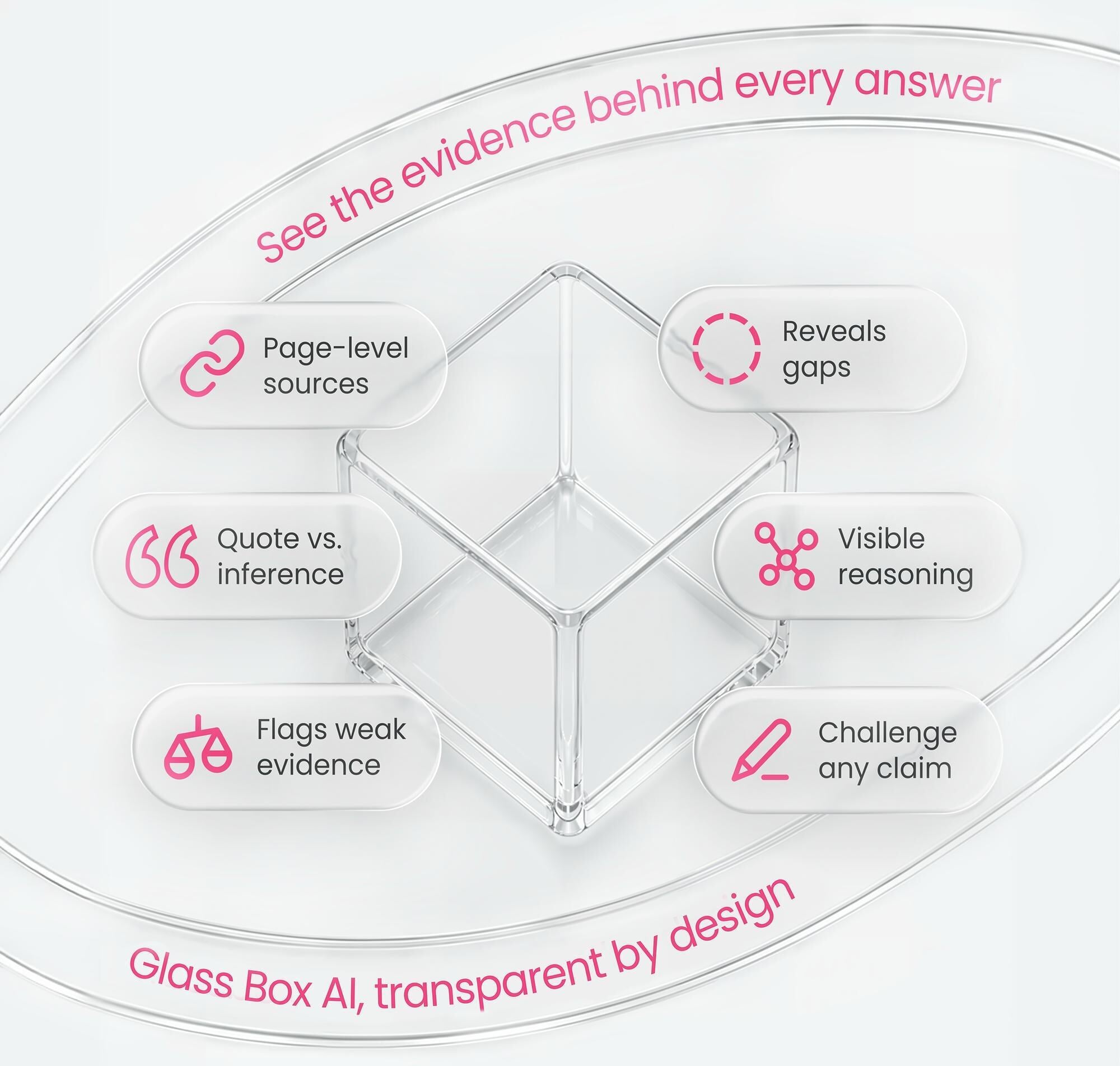
What will it take to mitigate the risks of “black box” AI? Stravito has taken on this challenge, introducing a “Glass Box AI” model to inform its AI tools. Known internally as Stravito’s Glass Box AI framework, it makes the AI system’s inputs, outputs, and decision-making rationale visible. The framework comprises a set of principles that shapes how we build—reflected in both the interface and the decisions we make at the infrastructure and architecture level.
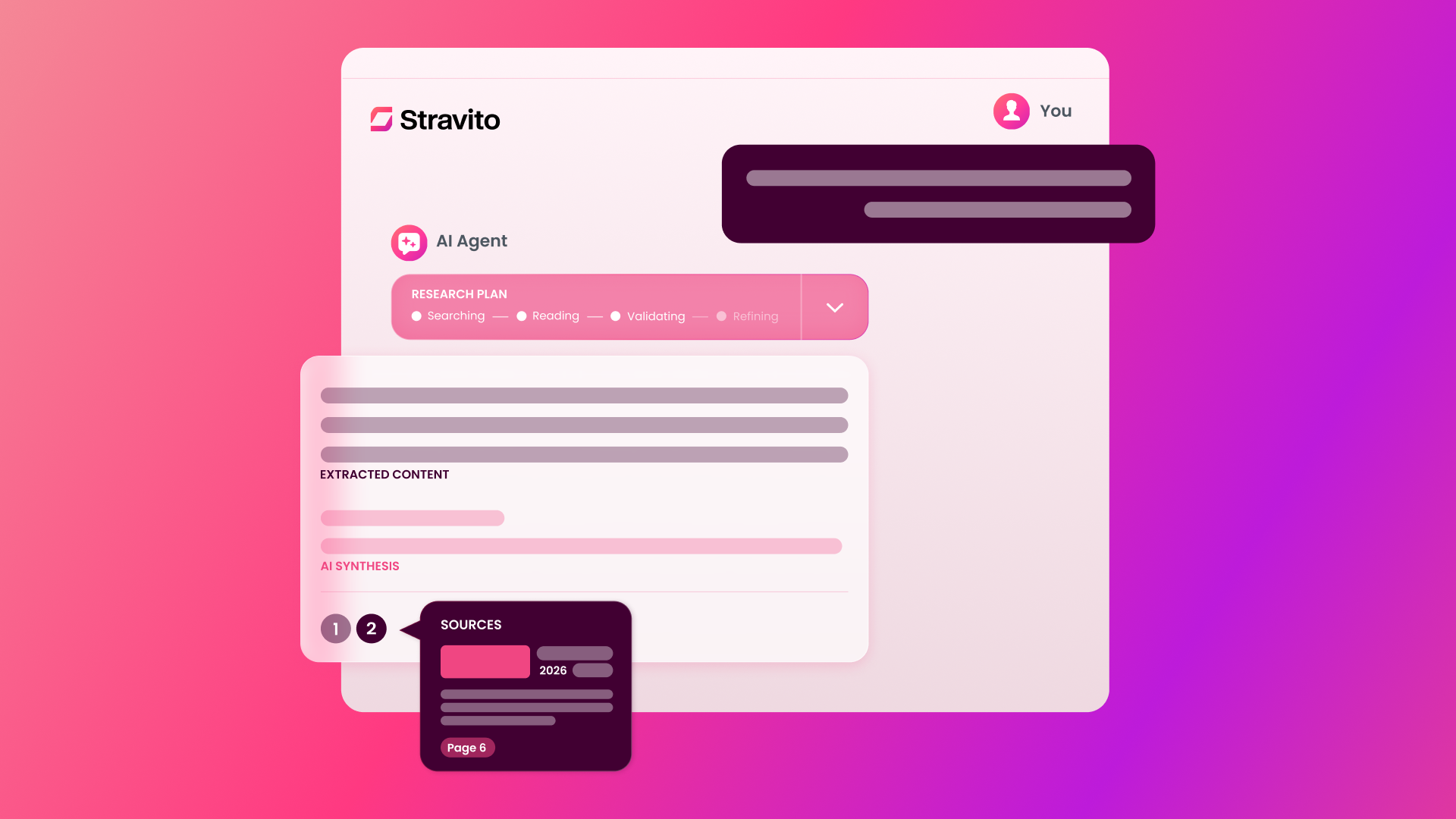
In Stravito AI Assistant, every answer cites sources: not generic links, but specific pages from proprietary research. The Deep Research Agent goes further, exposing the reasoning steps behind its conclusions — including quality loops, iterative refinements, and any gaps identified in the knowledge base — so users can follow the full chain of logic, not just the output.
AI Personas extends this commitment with footnotes and sources, with planned support for distinguishing simulated from extracted references. Together, these features represent a deliberate progression toward transparency — the core promise of the Glass Box AI framework.
Seven key principles serve as the pillars of the framework:
#1—Overt, retrievable reasoning
The digital reasoning behind an AI’s recommendations should be retrievable if users want to know how the AI did its “thinking” on a particular issue. For instance, if the AI report says that consumers in California buy the CPG company’s kind of products in convenience stores, how did it reach that conclusion? In the Glass Box AI model, each output should include a retrievable view of the evidence considered by the AI, filters applied, and synthesis logic. Users should be able to surface the view of this information easily in a form that’s comprehensible to a non-technical person.
#2—Traceability of sources
Each claim in an AI-based analysis needs to be traceable to an exact passage or page. Users should have quick, intuitive access to specific evidence, rather than entire documents or bibliographies contained at the end of an AI report. For example, if there’s a data point supporting the idea that the convenience store channel is expected to grow, a user who taps on the citation should quickly reveal the verbatim excerpt or the spreadsheet cell for the citation, including a source name and date.
#3—Clarity on inferences vs. real quotes
AI reports often contain inferences or synthesized summaries, e.g., convenience store customers ages 24-35 prefer small package sizes. Is this a verbatim quote from a valid source or an inferred claim? The Glass Box AI model would present verbatim quotes and inferred claims or synthesized summaries using distinct visual treatments, such as typography or color.
#4—Openness around evidence strength and uncertainty
The Glass Box AI model is predicated on the notion that a confident-sounding claim on thin evidence is worse than no claim at all. AI reports should present the details of the evidence it used to make a claim. This is especially relevant if the evidence is weak, e.g., citing a survey of 10 people to support a claim that supermarket sales will not suffer if the company expands into convenience stores. This will flag the conclusion as being poorly supported and invite questions to clarify the finding.
#5—Revelation regarding missing information
A Glass Box AI report will reveal the information it could not find. If there is no evidence to support a claim about supermarket revenue cannibalization, one way or the other, decision makers should know that. If anything, what wasn't found is often the most valuable finding. Gaps will ideally be discussed in the report body, not the footnotes.
#6—User authoring rights
Users of a Glass Box AI system should have authoring rights over the system’s judgement. They should be able to challenge, override, or amend the AI’s claims—with their reasoning included in the amendments. For example, if the AI says that convenience stores will charge more for the product than supermarkets, but Joe from the product management team disagrees, he should be able to challenge the finding while preserving the original claim for later review.
#7—Narrated latency
When the system takes time to produce an answer, that time is used to show what it is doing. It shows the documents being searched, passages identified, convergence checked, and weighting applied. By narrating latency, the system shows that the work was done. The process also enables mid-flight intervention. For instance, a user who sees a pre-pandemic consumer buying behavior study being weighted as primary evidence can stop the run and downweight it before the synthesis completes.
The value of surfacing uncertainty
Uncertainty is valuable in decision making. It pays to know the unknowns in a situation. The alternative, which is to base a decision on thinly backed claims, amplifies the risk of making the wrong decision. This may seem counterintuitive in a business world that sometimes conflates confidence with leadership to the detriment of commercial outcomes. It is better to say, “We don’t know this,” and proceed to an informed discussion than to say, “We know this, because the machine said so, so there’s no need to discuss.”
Identifying an unknown or a point of uncertainty can open up a productive “pro vs. con” dialogue around a decision. Or, knowledge of unknowns can set the stage for interventions to remediate the uncertainty, e.g., run a study, pay for syndicated research, generate synthetic responses from a persona, and so forth. If you have false certainty you will never know that you need to gather more evidence.
In the CPG company case, for example, discovering that there is uncertainty around the potential price point of the product in the convenience store channel could trigger a discussion of whether manufacturing can scale to bring production costs down. Without the uncertainty, that conversation may never have begun. In a situation like that, uncertainty can reveal a larger strategic issue, such as earnings risk due to cost pressures. It invites questions that stakeholders may not have even known they had.
Conclusion
The era of overconfident AI is drawing to a close as users recognize the risks it poses to coherent and impactful decision making. Decision makers are coming to the realization that the black box answer is not fit for purpose. In its place comes a new Glass Box AI model, which enables stakeholders to gain the benefits of transparency and lean into uncertainty when it emerges in the AI analysis. Stravito is operationalizing the Glass Box AI model through principles of overt digital reasoning, clarity on citations, and more with its own Glass Box AI framework.

See how Stravito can help your team
If your insights are scattered across tools, folders, and inboxes, and your teams are dreaming of a “Google for research,” we’d love to talk.


Author