

Organizations have invested heavily in data, analytics, AI, and insights tools. Yet the intelligence decision-makers need often remains fragmented. A Decision Layer can connect and consolidate those inputs, applying organizational context, standards, and judgment to deliver decision-ready intelligence.
TL;DR
- More reports, dashboards, and AI outputs do not automatically lead to better decisions when intelligence remains fragmented across systems.
- Build and Buy solve different needs, but even a Build + Buy approach can leave competing sources of truth and a gap between insights and decisions.
- The Decision Layer is a consolidation and reasoning layer that connects enterprise knowledge with human decision-making, applying organizational context, standards, and judgment to deliver decision-ready intelligence.
- In our new report, "The Enterprise Decision Layer", we explore in-depth why intelligence isn't reaching decision-makers and key frameworks like the Decision Layer and the Insight Maturity Matrix that can help you tackle these challenges.
Why enterprise intelligence remains fragmented
Executives can access more reports, dashboards, and tools than ever, yet still enter a critical decision without a coherent view of the evidence.
That is the uncomfortable reality behind many investments in enterprise intelligence. More intelligence is available, but it does not reliably reach decision-makers in a form that helps them act when it matters most. Research is stored in one place, analytics in another, institutional memory is scattered across systems, and AI tools operate on the sources they can access.
The unresolved challenge is synthesis: bringing that knowledge together, evaluating it, and making it useful at the point of decision. Without that synthesis, decision-makers may receive partial answers, conflicting signals, or findings stripped of the context needed to interpret them.
Insights teams and Technology teams can both be doing strong work. But when their systems and strategies develop in parallel, their combined output can still fall short.
How Insights teams and Technology teams define success differently
Insights teams typically optimize for usability, accessibility, adoption, speed, and decision influence. Technology teams typically optimize for scale, governance, security, infrastructure, and control. Both sets of priorities are essential.
Problems emerge when those priorities shape separate systems and strategies, with no shared mechanism for turning their outputs into one decision-ready view.
AI can make this gap even more visible. When AI initiatives develop in parallel, they can add another source of output without addressing the fragmentation beneath it. A copilot may retrieve from the data it can access while missing relevant consumer research or institutional knowledge. A self-service portal may make research easier to find while remaining disconnected from current analytics.
Each tool works within its mandate, but no one owns the synthesis.
For senior insights leaders, this creates a strategic risk. As enterprise AI programs gain attention, organizations may mistake faster access to more data for better intelligence.
Access is only one part of the problem. The harder work is determining what evidence matters, how different sources relate, why credible findings conflict, and what context a decision-maker needs.
Why Build + Buy can still leave intelligence fragmented
For years, organizations have framed technology choices as a question of whether to Build or Buy.
Build is well suited to infrastructure, extensibility, governance, integration, and security. Buy can deliver usability, activation, adoption, and speed-to-value. Both approaches solve important problems, but neither was designed to solve the full decision intelligence problem.
A Build + Buy model can combine vendor-supplied tools with custom-built infrastructure and interfaces. But even a well-engineered model can still leave an organization with fragmented knowledge, competing sources of truth, and a gap between insights and decisions.
That makes the more useful question:
How will the intelligence created across both environments be connected, evaluated, and delivered into the decisions the business is making?
What is the Decision Layer?
What’s missing is an operational layer between the systems that hold enterprise knowledge and the people expected to act on it.
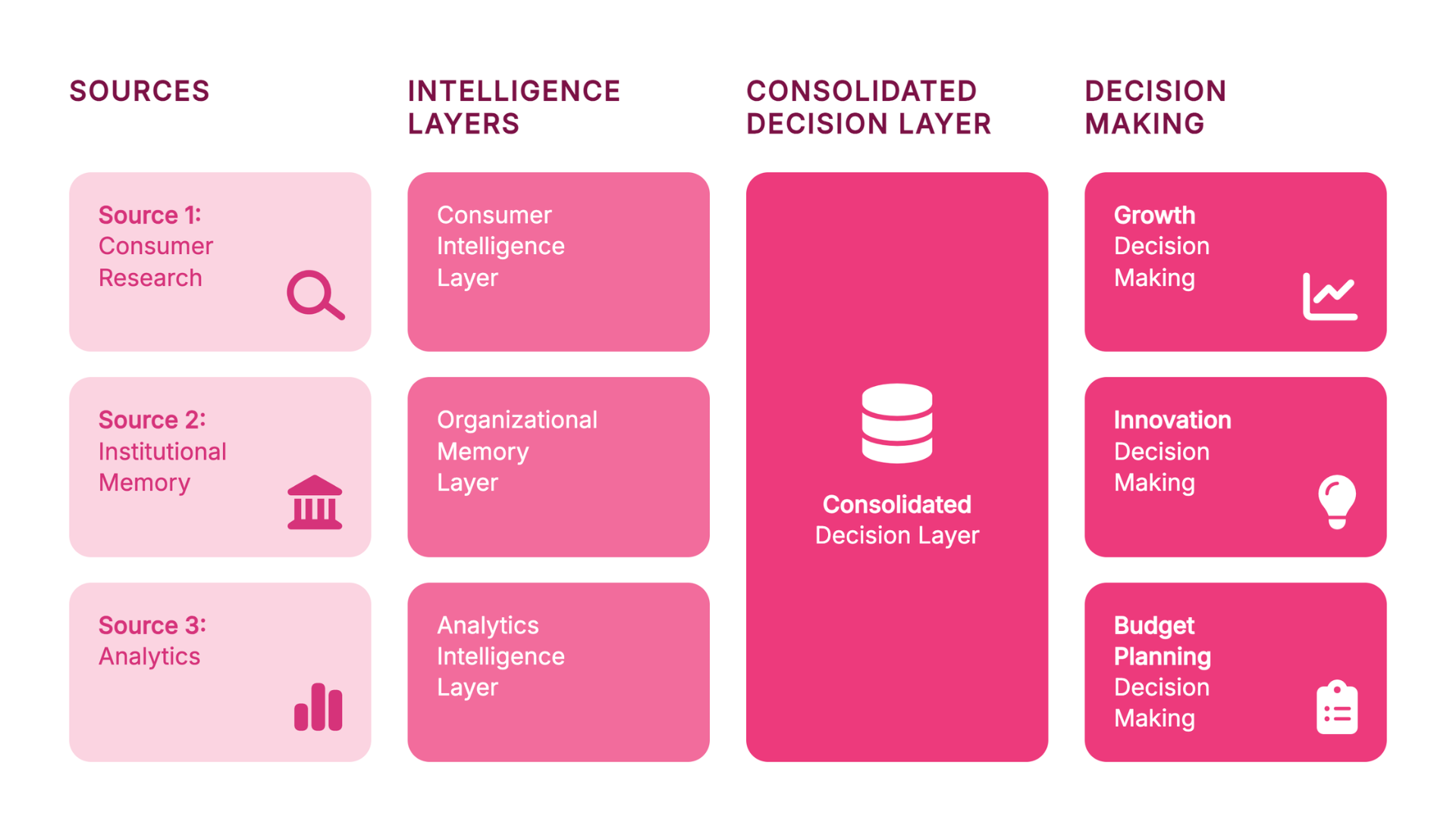
The Decision Layer is a consolidation and reasoning layer situated between enterprise data infrastructure, business applications, and human decision-making. It brings together fragmented inputs such as consumer research, analytics, and institutional memory, then applies organizational context, standards, and judgment to deliver decision-ready intelligence.
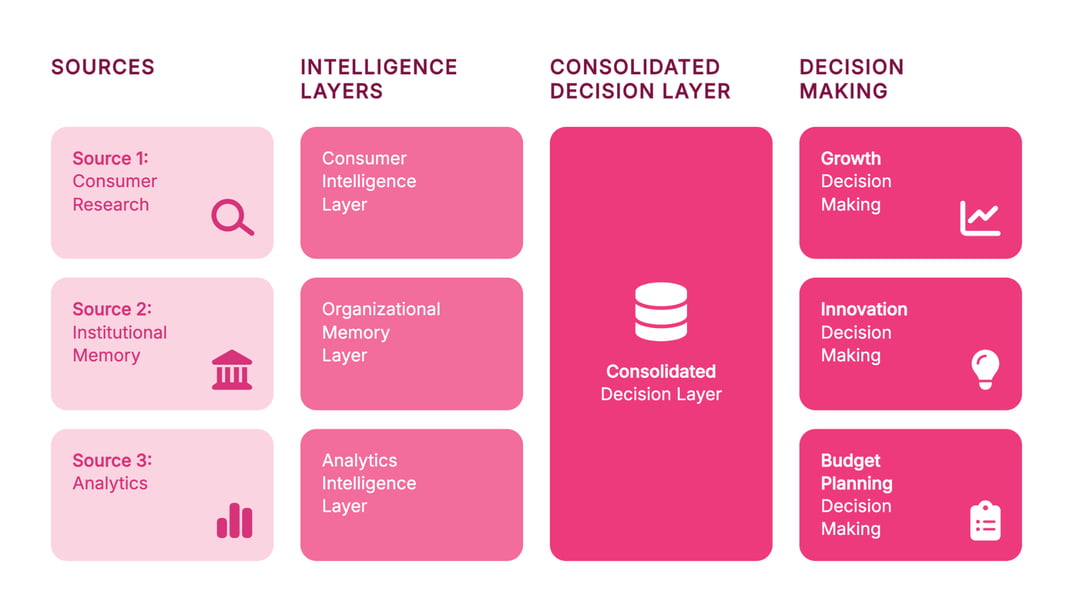
The Decision Layer blends enterprise sources with intelligence layers to add useful intelligence to decision-making processes.
How the Decision Layer creates decision-ready intelligence
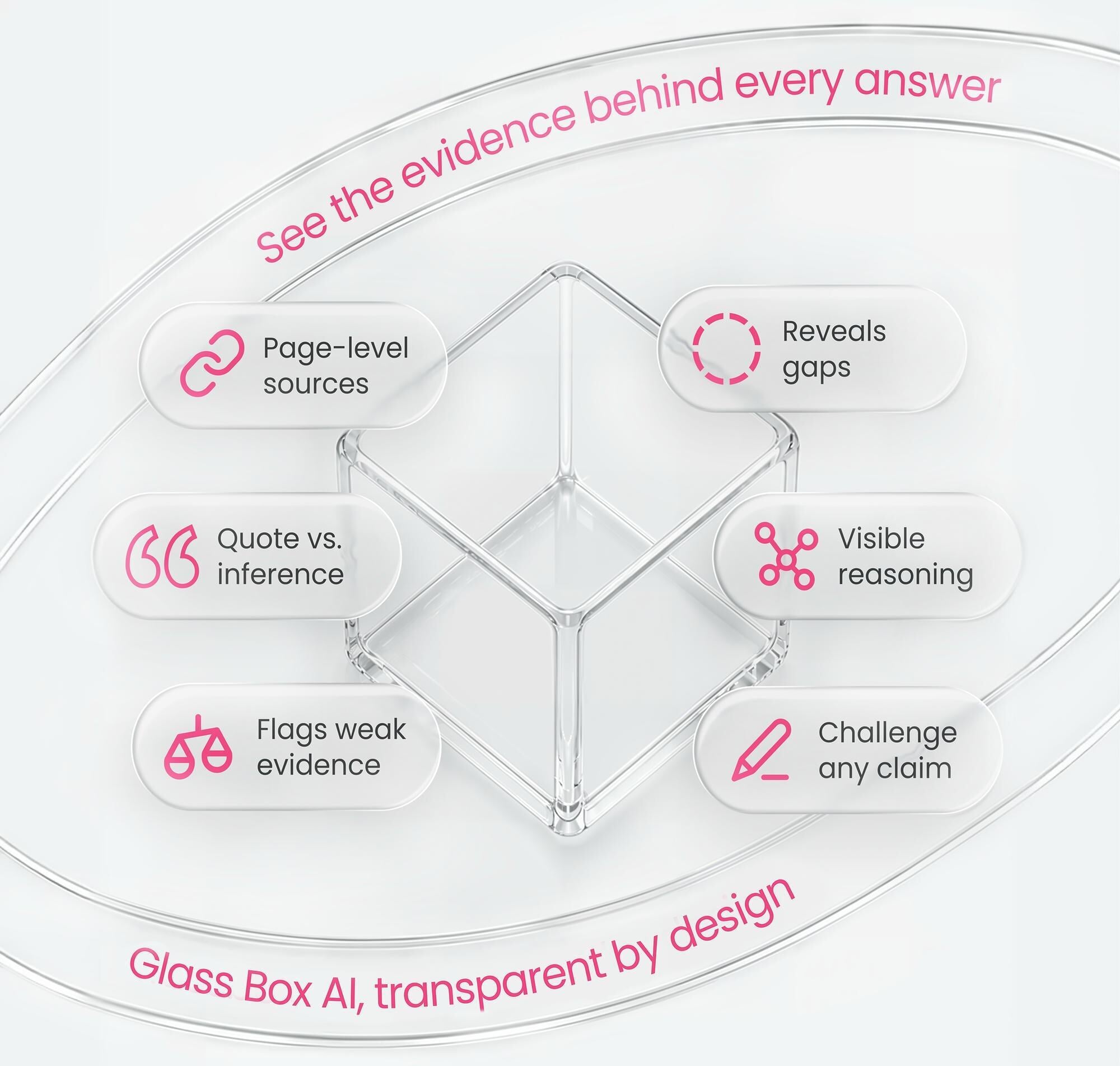
The Decision Layer goes beyond linking systems. A “thinking layer” driven by AI, it sits above fragmented systems and data sources, enabling organizations to synthesize knowledge and evaluate evidence.
This helps users identify gaps in the data, challenge assumptions, and understand how different findings relate. For decision-makers, the result is intelligence that is contextual, trusted, synthesized, and decision-ready.
From Build + Buy to Build + Buy + Connect
Connect is the missing verb.
The Decision Layer reframes the familiar Build vs. Buy debate as Build + Buy + Connect:
- Build for infrastructure, governance, and enterprise architecture
- Buy for usability, activation, and speed-to-value
- Connect to unify intelligence, consolidate knowledge, operationalize reasoning, and deliver intelligence at the moment of decision-making
Connect means more than linking systems or consolidating sources. It adds the reasoning capabilities needed to turn fragmented inputs into actionable knowledge.
Rather than replacing existing investments, the Decision Layer amplifies them by connecting infrastructure, insights, and AI into a unified decision ecosystem.
This also creates a path for Insights teams to grow in maturity, increasing their influence on decisions and strengthening engagement with senior stakeholders.

Explore the Decision Layer and Insight Maturity Matrix
Stravito’s report, The Enterprise Decision Layer: A New Foundation for Smarter Decisions, examines the structural gap between enterprise intelligence and decision-making and explains how Build + Buy + Connect creates a path forward.
It also introduces the Insight Maturity Matrix, a framework for assessing decision intelligence readiness and mapping the path from fragmented knowledge toward greater influence.
Want to dive even deeper?
Join us for our upcoming webinars that explore these topics in-depth.
Part 1: From Fragmented Data to Confident Decisions
📅 August 20 | 10 AM ET / 4 PM CEST
Part 2: The Insight Maturity Matrix – and Where AI Strategy Fits
📅 September 1 | 10 AM ET / 4 PM CEST


Author