

TL;DR:
- AI personas are dynamic profiles generated from your research corpus using large language models.
- They reduce manual work in the persona creation process and surface data-driven insights in minutes.
- They evolve as new research is added, giving teams more accurate personas supported by real evidence.
- They help product, brand, and insights teams align on the same understanding of target customers across markets.
You’ve probably noticed the surge in conversations around AI personas this year.
But even with all the buzz, many enterprise insights leaders still ask the same question:
What exactly are AI personas, and how useful are they in real research workflows?
The term is often misused. Some imagine AI-generated personas built from generic content, while others think of synthetic profiles that replace actual user research.
In reality, AI personas are far more practical. They turn research data, customer feedback, and interview transcripts into clear, evidence-linked profiles that support faster briefs and better decisions.
They don’t replace human insight. They extend it.
Today, you’ll learn
- how AI personas work,
- where they add value,
- how they compare to traditional personas and synthetic personas,
- and why enterprise insights teams are adopting them now.
You’ll also see how organizations are using them responsibly with Stravito AI Personas.
To ground the rest of this guide, here’s the simplest way to explain what AI personas are and how they work.
AI personas, simply explained
AI personas only become useful when you understand what they are built from, how they differ from common misunderstandings, and where they actually help teams move faster.
Definition
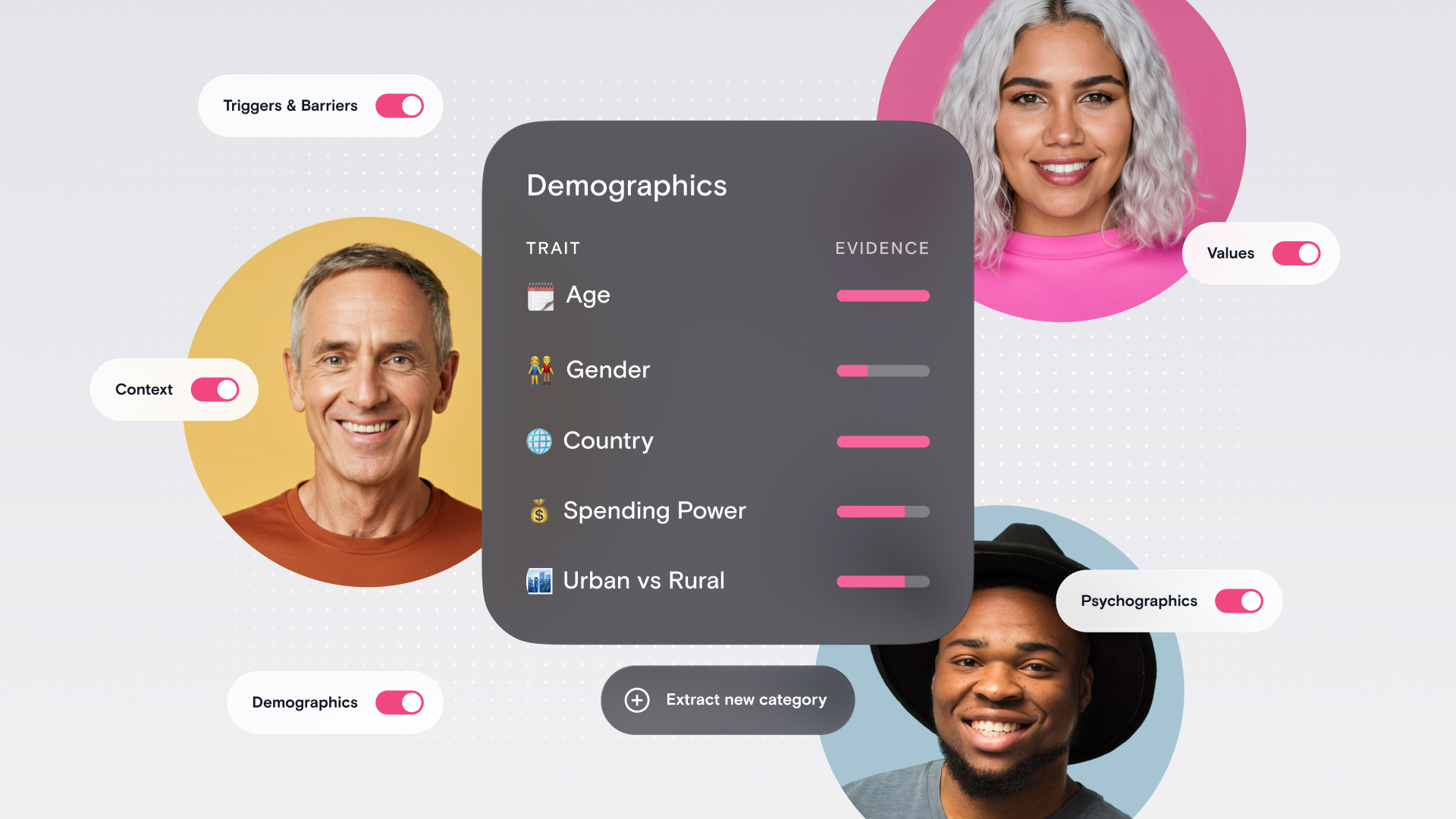
AI personas are dynamic profiles generated from your approved research and context. They pull from evidence, not assumptions. At their core, they are:
- summaries of patterns found in research data, customer feedback, interview transcripts, and market facts
- profiles that link each point back to its source for transparency
- dynamic documents that update automatically as new evidence is added
What AI personas are and are not
A simple way to see the difference:
|
AI personas are |
AI personas are not |
|
Evidence-linked profiles built from actual data |
Fictional composites without sources |
|
Dynamic and updated as new research is added |
Static personas that become outdated |
|
Designed to reflect human insights and patterns |
Synthetic stand-ins that replace real users |
|
Helpful for scaling briefs, decisions, and early hypotheses |
A substitute for actual user research or fieldwork |
|
A practical layer on top of your existing research corpus |
Personalized messaging or marketing shortcuts |
When they add value
AI personas help when speed, scale, and consistency matter.
They make it easier to create personas for new briefs, support early hypothesis development, reduce duplicate research, and keep cross-functional teams aligned on the same understanding of target customers.
They are especially useful for organizations that manage multiple personas across markets, product lines, or regional teams.
Why leading insights teams are adopting AI personas now
AI personas are gaining traction because they help insights teams move faster, stay aligned, and reduce rework. Here is how they support day-to-day decisions.
Faster cycles and fewer dead ends
A strong knowledge management framework gives teams a structured way to store research, so AI personas can pull from that corpus and speed up early-stage work.
Teams see value because AI personas help them:
Move quickly
- generate a first draft persona in minutes
- reduce duplicate research
- prepare early hypotheses with less effort
Spot gaps earlier
- surface missing data
- highlight weak evidence
- suggest areas for validation
This shortens the path from a question to a usable brief.
Evidence continuity across functions
A clear sense of user behavior and customer needs is hard to maintain in large organizations. AI personas support that continuity by grounding each insight in the underlying evidence.
Teams use AI personas to:
- align product, brand, and CX around the same understanding of the target audience
- link research data to the persona directly
- avoid multiple “versions” of the same user story
- build briefs, journey maps, and hypotheses from shared facts
A well-defined persona becomes a stable reference point across functions.
Global consistency with local nuance
Enterprises that work across multiple markets often struggle with persona drift, so understanding how to create a knowledge base gives them one shared foundation for regional variations.
AI personas help global teams:
- start with a consistent core
- localize for language, culture, and channels
- adapt quickly as new insight is added
- support multiple personas without losing the thread
This gives regional teams flexibility without sacrificing global alignment.
Governance and trust
Responsible workflows make AI personas usable in enterprise settings.
Strong guardrails come from practices described in AI knowledge management, where context, provenance, and permissions shape how insights move across teams.
AI personas support governance by offering:
Transparent foundations
- source visibility
- clear confidence levels
- structured context
Operational control
- permission settings
- versioning and change history
- validation paths teams can rely on
This gives organizations a trustworthy way to scale persona work without losing oversight.
Now that we know why AI personas are gaining traction, it helps to compare them with the approaches teams already use.
This gives the full picture of how each method supports different stages of research and decision-making.
AI personas vs. traditional personas vs. synthetic personas
Many teams use the word “persona,” but the meaning changes depending on the method, the data source, and the intended use.
Some personas are built entirely from human research. Some rely on AI-generated content. Others are created from large language models that interpret customer data, market research, and user behavior.
Because these models serve different purposes, it helps to see the differences side by side.
This comparison shows how each approach handles evidence, speed, accuracy, and the persona creation process, and why AI personas are becoming a practical layer between traditional personas and fully synthetic ones.
How today’s persona types compare
|
Aspect |
Traditional personas |
AI personas |
Synthetic personas |
|
What they’re built from |
Interview transcripts, focus groups, survey data, demographic data |
Research data, customer feedback, online behavior, and industry reports stored in your research hub |
Model-generated assumptions not tied to actual data |
|
How they’re created |
Manual persona creation process |
Fast persona generation using large language models |
Created instantly by AI models with minimal inputs |
|
Evidence strength |
High, based on human insights from real users |
High, improves as more research data and data sources are added |
Low, not grounded in actual user research |
|
Best suited for |
Deep user personas, buyer persona details, journey maps, messaging |
Scaling multiple personas, briefs, data-driven insights, and business decisions |
Early concept exploration, marketing campaigns, and user journey simulations |
|
Main limitation |
Slow to update, manual process |
Dependent on the quality of research data gathered |
Must be validated through actual user research |
Why this comparison matters
Each approach supports different stages of customer journeys and decision-making.
Traditional personas bring depth. Synthetic personas allow quick exploration. AI personas help teams generate more accurate personas at scale using the evidence they already have.
Seeing these differences clearly helps insight teams, product managers, and sales teams understand where AI personas fit and how they can support diverse audiences, regional needs, and complex workflows.
That naturally raises the next question. Which components make an AI persona clear enough, reliable enough, and practical enough for everyday decision-making?
The 6 core components of a high-quality AI persona
Every AI persona is different, but strong ones share a similar structure. These components help teams move from data to clarity, and from clarity to decisions that make sense for real users.
1. Jobs to be done and switching triggers
Jobs to be done and switching triggers clarify the outcome the persona wants, what motivates them to move, and the friction that gets in their way.
Strong AI personas highlight:
- the primary job to be done
- switching triggers and moments of friction
- signals that influence the decision-making process
This gives product managers and insights teams a clearer view of early behavior patterns.
2. Barriers, anxieties, and must-win moments
Accurate personas describe both emotional and practical blockers. These details often come from actual user research, customer feedback, and research data gathered from interviews, focus groups, and survey data.
Teams rely on this to:
- identify what slows progress
- surface fears or misconceptions
- highlight must-win moments in the user journey
3. Context cues across markets and channels
Understanding where a persona interacts helps teams create realistic journey maps.
This part captures:
- market conditions
- cultural or regulatory notes
- channel differences
- online behavior patterns
4. Evidence map
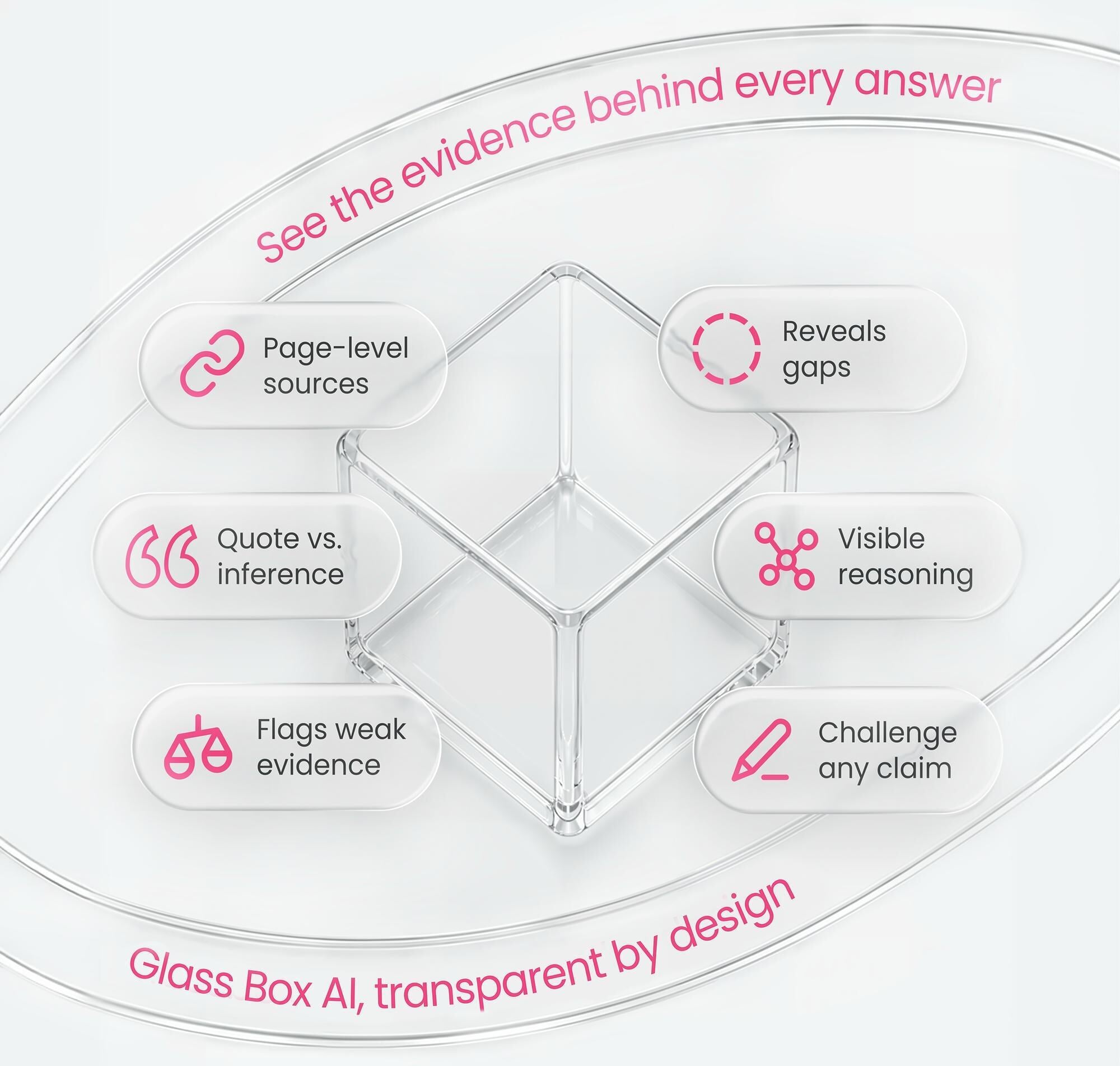
Reliable AI personas show the evidence behind every point.
Many teams build this using ideas similar to the approach in building better personas, where each insight links back to the underlying source.
An evidence map typically includes:
- interview transcripts
- research data from past studies
- customer feedback
- data sources from your research hub
5. Confidence notes and recency
Not all insights carry the same weight.
Strong AI personas show:
- which points rely on older data
- where evidence is recent
- which statements require validation
- where gaps exist in the persona creation process
This prevents teams from making decisions based on outdated or incomplete information.
6. Clear guidance for use
A high-quality AI persona explains how it should be used across the organization.
This often covers:
- which decisions the persona should inform
- where it supports business decisions
- how persona interacts with roadmaps and marketing campaigns
- which teams should use it and when
This helps teams prioritize projects and develop personas that stay relevant as the data grows.
Once the core components are clear, the next question becomes how teams create AI personas in a way that stays responsible, transparent, and grounded in evidence.
A step-by-step workflow for creating AI personas (and keeping them honest)
AI personas work best when they’re built from trusted evidence, guided by clear decisions, and validated by people. This workflow helps teams create strong personas without losing oversight or quality.
Step 1: Gather and gate the corpus
A strong persona starts with a reliable source of truth.
A clear knowledge management framework helps teams decide what belongs in the research corpus and what should stay out.
Most teams include:
- interview transcripts
- focus groups
- survey data
- customer feedback
- market research and industry reports
- data gathered from past projects
Step 2: Define the decision and the audience
Choosing one upcoming decision and one clear target audience prevents drifting toward generic user personas that do not map to real users or real needs.
Step 3: Generate the first draft
AI models help teams create AI personas quickly.
A first draft generated from the evidence you already have gives you structure, behavior patterns, and an early read on needs and pain points.
Step 4: Antagonize and compare
Teams get better results when they pressure-test early versions.
A simple way is to generate a second or third variant, then compare them to see where the evidence aligns, where contradictions appear, and what needs more validation.
Step 5: Run bias and inclusivity checks
Responsible workflows matter, especially for global teams.
Patterns from AI knowledge management help teams check for representational gaps, outdated assumptions, or missing perspectives across diverse audiences.
Step 6: Validate with humans
AI personas should never replace real users.
Teams use micro-tests, quick interviews, or existing feedback to confirm:
- the accuracy of behavior patterns
- the relevance of needs and motivations
- which parts need refinement
This keeps personas grounded in actual user research.
Step 7: Publish with provenance
Publishing is easier when teams follow practices like the ones described in synthetic personas, where provenance and context come first.
A strong AI persona includes:
- linked evidence
- confidence levels
- recency notes
- validation status
Step 8: Reuse and localize
AI personas shine when teams need multiple personas or regional versions.
A shared structure makes it easy to start with a global base, then localize for culture, channels, and behavior without losing consistency.
Step 9: Maintain and refresh
Personas only stay accurate when the evidence stays fresh. Teams revisit and refine the persona as new customer data and research studies arrive.
With a clear workflow, the next question is how these personas actually show up in real work. The upcoming section looks at high-impact use cases where teams see the biggest gains.
High-impact use cases for AI personas (with mini examples)
AI personas show their value when teams use them to speed up everyday work. Here are the use cases where insights and product teams see the biggest gains.
1. Brief building in hours, not weeks
AI personas help teams create personas for early briefs without digging through scattered research.
Teams working in AI personas for B2B marketing use this to turn customer data, interview transcripts, and behavior patterns into concise briefs that make sense for their target audience.
Mini example:
A brand team quickly generates persona variants for a concept brief, compares switching triggers, and aligns on which buyer persona to target.
2. Concept validation scaffolding
Strong briefs make validation easier.
The ideas covered in concept validation testing help teams pair research data with early hypotheses before any fieldwork begins.
Teams often use AI personas to:
- surface pain points
- create AI-generated personas for different segments
- map user needs to stimuli
- prepare fast-win tests
Mini example:
A product team identifies must-win moments and turns them into three testable concept angles for a new feature.
3. Market entry and localization
Global teams often need multiple personas or ux personas for different markets.
AI personas help teams keep the same understanding across regions, then localize based on:
- online behavior
- cultural context
- channel realities
- demographic data
When applying this approach, you can reference the methods behind Lavazza Group’s AI Personas to strengthen alignment.
Mini example:
A regional insights manager localizes a global persona into three variants for different markets without restarting the persona creation process.
4. Sales and success enablement
Sales teams need more accurate personas to understand user needs, objections, and behavior patterns.
AI personas help them:
- find key points in the decision-making process
- build data-driven profiles from actual data
- support project management for complex deals
Mini example:
A sales team pulls customer feedback linked directly to the persona’s evidence map to refine a pitch for an ideal customer profile.
5. B2B account personas
For B2B, teams need persona clusters across job titles, roles, and buying committees.
AI personas help product managers and marketers:
- generate personas quickly for each role
- map customer journeys and user journey maps
- understand how a persona interacts with others in the decision chain
Mini example:
A product team models three role-based personas for procurement, IT, and operations to prepare for a cross-functional launch.
6. Support knowledge and deflection
AI personas help support teams understand user stories and behavior patterns across diverse audiences.
This leads to:
- better help-article prioritization
- faster routing
- clearer self-service content
- reduced manual process for categorizing issues
Mini example:
A support team identifies recurring pain points from persona-linked research data and updates its top self-service flows.
7. Roadmap prioritization
Teams use AI personas to score opportunities based on user needs, customer journeys, and data gathered from ongoing research.
This improves business decisions by highlighting:
- unmet customer needs
- friction in the user journey
- gaps in available data
Mini example:
A roadmap team compares persona variants to decide which capability has the strongest user need and should move to the next sprint.
Across all of these use cases, the pattern is the same. AI personas help teams move faster, avoid duplicated effort, and make decisions with more confidence because every insight traces back to real evidence.
They give product, brand, and insights teams a shared view of what customers need and what gets in their way.
Once these use cases are in motion, the next question is how to measure the impact.
The metrics below help teams see both early signals and long-term value as AI personas become part of their daily workflow.
Metrics: how to measure value
AI personas make the most impact when teams measure how they improve research flow, alignment, and decision-making. These indicators help you track both early signals and long-term outcomes.
Leading vs. lagging indicators
|
Leading indicators |
Lagging indicators |
|
Time to first persona |
Time from idea to concept test |
|
Percentage of briefs with linked evidence |
Pre-launch kill or pivot rate |
|
Reuse rate across markets and teams |
Duplicate research avoided |
|
Stakeholder digest open rates |
Adoption or engagement lift linked to personas |
|
How often teams return to persona insights |
Reduction in manual process time |
|
Number of persona variants created |
Improvements in clarity across cross-functional teams |
A simple ROI model
A straightforward way to estimate ROI is:
(Hours saved × blended rate) + (duplicate study cost avoided) + (cycle-time reduction × value per week)
This helps teams quantify how AI personas reduce rework, speed up planning, and improve business decisions.
Once you can measure the impact of AI personas, the next step is understanding how to bring this work together in one place with the help of Stravito.
How Stravito AI Personas helps
Stravito AI Personas helps teams bring human research and AI-generated insight together in one place. It gives you a practical way to generate personas quickly, compare versions, and keep everything tied back to real evidence.
The goal is simple: help your organization make clearer, faster decisions without losing trust or transparency.
One hub for human and AI personas
Many teams want AI personas without creating another standalone tool.
That is why Stravito AI Personas sits inside your existing research environment, next to the work your team already does.
Human-built personas, AI-generated personas, interview transcripts, customer feedback, and research data all stay connected in one place.
Built-in guidance backed by evidence
Teams get more accurate personas when they work from structured insight.
The ideas in building better personas show why evidence mapping matters.
Stravito AI Personas uses the same logic by linking every detail to its source, capturing recency notes, and giving teams a clearer, more comprehensive view of what shaped the persona.
Variant comparison and localization
Global teams often need multiple personas for different markets, channels, or job titles.
Stravito AI Personas makes it easy to:
- compare persona variants side by side
- find differences in behavior patterns
- localize for region or language
- support diverse audiences at scale
This helps regional teams stay aligned while still adapting to local needs.
Responsible AI controls built in
Good governance should not feel heavy.
Stravito AI Personas builds in:
- provenance
- version history
- permissioning
- data privacy protections
- bias checks
These controls make it easier to reuse personas, refresh them, and share them without losing oversight or accuracy.
If you want to try this in a real workflow, the next steps are simple and take very little time.
Next steps
AI personas become most useful when teams test them in a real workflow. These two actions help you get started without disrupting ongoing work.
Try this
- Pick one initiative
- Generate an AI persona draft from approved research
- Run a five-interview validation
- Publish it with confidence notes
A small experiment is enough to show what works.
See Stravito AI Personas in action
If you want to centralize research, generate personas responsibly, compare variants, localize for regions, and keep strong governance in place, Stravito AI Personas gives you one hub to do that work.
You can explore how it fits your team by starting with a quick walk-through using a request a Stravito demo.
FAQs
What are AI personas?
AI personas are evidence-linked profiles created by large language models from your approved research corpus. They combine research data, customer feedback, and interview transcripts into a single customer persona that updates as new insights arrive. They answer “what are AI personas” by giving teams a fast way to develop personas created from actual data rather than assumptions.
Do AI personas replace human research?
No. AI personas support human insights, but they never replace actual user research. They help teams analyze available data, surface early patterns, and suggest where to look next, but every important decision still depends on real users and field validation. AI personas help you move faster, not skip the work.
How do we keep AI personas accurate?
Accuracy comes from grounding every detail in evidence. Teams update personas when new research closes, check for bias across diverse audiences, and confirm findings through lightweight validation interviews. This keeps the persona creation process tied to comprehensive context rather than relying on an ai system alone.
Can AI personas work for B2B buying committees?
Yes. AI personas help map role clusters, job titles, and decision paths inside complex buying groups. They make it easier to understand how each persona interacts with others, identify shared pain points, and generate personas for cross-functional journeys. This is especially helpful when traditional personas slow down global teams.
FAQ Title
Most teams refresh personas when new research data arrives, behavior shifts, or strategy changes. Regular updates ensure more accurate personas and prevent outdated assumptions from shaping business decisions. Even a simple review triggered by one specific example, such as a new concept test, helps teams stay aligned.
In this blog
Author